
How Reality.eth Works
Reality.eth operates as an on-chain Q&A oracle where users can post questions and stake deposits to provide answers. If someone disagrees with a posted answer, they can challenge it by submitting a new answer with double the previous deposit. This mechanism creates an exponentially increasing cost to modify a response, making dishonest behavior financially unviable. To ensure accuracy, Reality.eth also allows for arbitration by an external dispute resolution system. In Fantasy Tier, Kleros Court serves as the final adjudicator. If a challenge escalates to Kleros, jurors review the case and issue a binding decision, securing a fair resolution.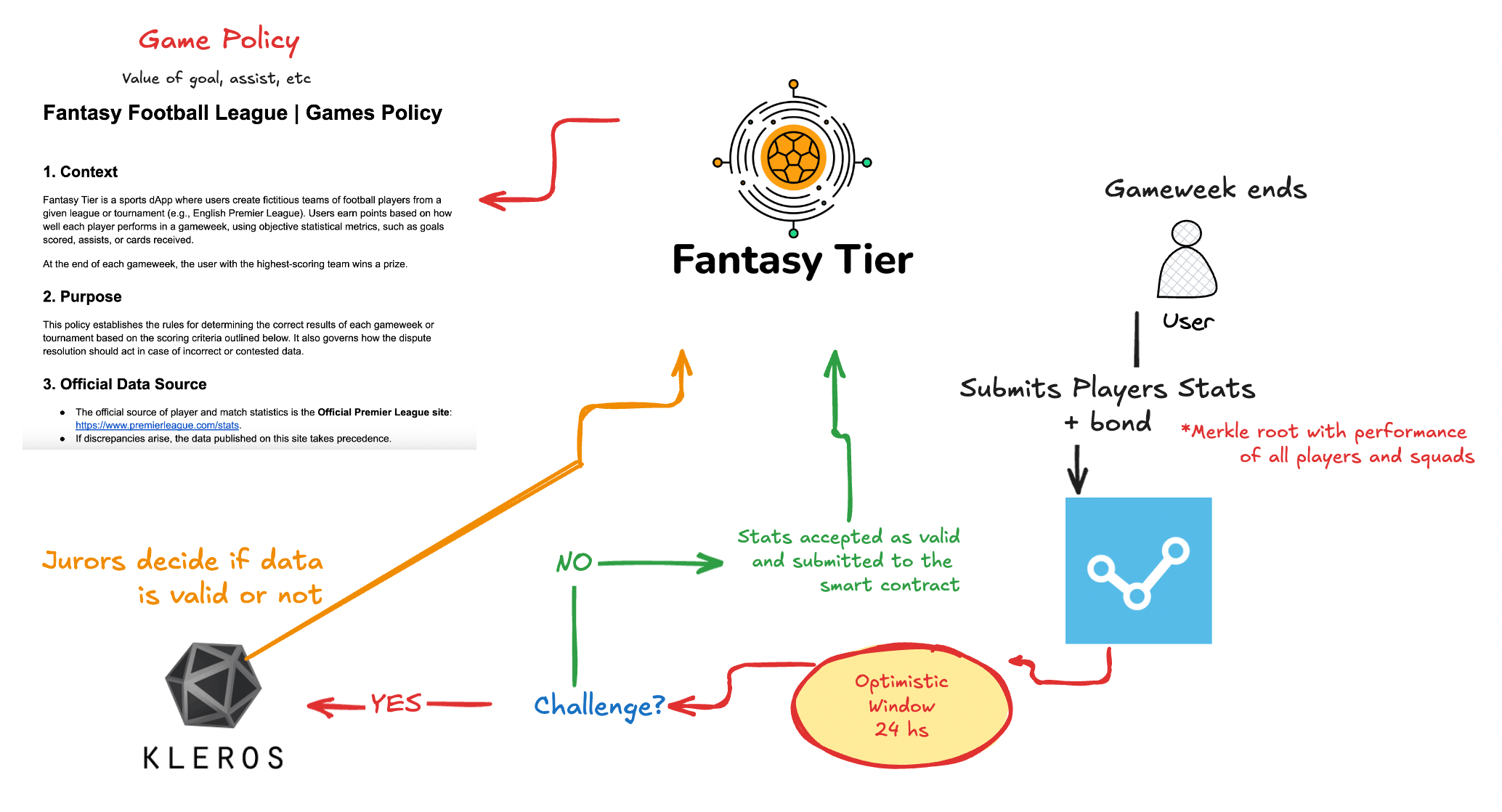
Adaptation for Fantasy Tier
Unlike traditional implementations where individual event outcomes are reported directly, Fantasy Tier optimizes this process by using Merkle trees. Instead of submitting answers for each player’s performance separately, Reality.eth will only store a Merkle root, which serves as a cryptographic commitment to a dataset containing all players’ scores. This approach:- Reduces gas costs, as only a single hash (Merkle root) is stored on-chain.
- Increases efficiency, allowing bulk verification of fantasy scores in a single transaction.
- Maintains verifiability, as anyone can reconstruct the Merkle tree off-chain and confirm its correctness.